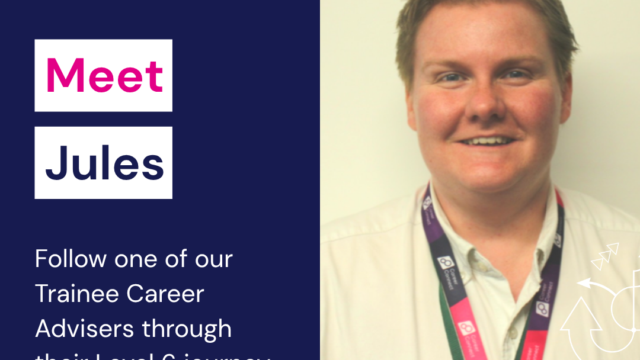
Continue to follow the journey of our Trainee Careers Adviser, Jules O’Neill-Crane, as they make progress through their Level 6 Diploma in Careers Guidance and Development.
How long does a Level 6 Diploma take?
The Level 6 Diploma can take on average 18-24 months to complete all 7 mandatory units and 3 optional units, including the taught sessions, workbooks, observations, and evidence gathering.
You can learn more about the Level 6 Diploma here.
How was your first month?
"It's definitely been a learning curve but lots of fun too! I'm currently supporting four secondary schools in Warrington and Birkenhead. The biggest challenge so far has been balancing my time between one-to-one guidance interviews with Year 11s and writing up action plans and organising career events. That said, I already feel like I'm settling into the rhythm of the role. I've had the opportunity to support a range of engaging careers activities, from mock interviews to careers days, and I've particularly enjoyed working with students in Alternative Provision settings. Building relationships with students across all of my schools has been one of the most rewarding parts of the job so far."
What have you undertaken so far as part of the qualification?
An opportunity came up to draw on the experience from my previous job and develop new inclusion training for Career Advisers in our Justice Services team (who work in Prisons across the country). My assessor very cleverly identified how this work could contribute towards two optional units, 23 [Plan, deliver and evaluate presentations] and 26 [Plan, deliver and evaluate career-related learning in groups], both of which assess the ability to design and deliver training. I'm also nearly ready to submit Unit 1 [Preparing to work in the career development sector], and next week I will begin work on Unit 3 [Career guidance theory career guidance and development theories and models].
What have you found to be the key piece of learning at the beginning of the qualification?
“One of my biggest learnings this month has been understanding just how many people contribute to an effective careers programme within a school. Careers Leaders play a vital role, but I've quickly learned that the strongest programmes draw on the expertise of a much wider team, including SENDCOs, Pupil Premium leads, teachers responsible for children in care, heads of year, and many others. Bringing together the knowledge and insights of these colleagues helps me give students advice which is tailored to individual circumstances and enables me to better support them in overcoming any barriers they may face.”
How have you found balancing your learning with undertaking a role in schools?
“My assessor and the training team have already been so helpful in linking up what I'm already doing at work with the qualification. I'll need to evidence why and how my experience links to the qualification, but they've really helped me identify what experience I've gained and how I can use it. Time has flown in this first term, so I've had to make sure that deadlines don't run away with me, but my assessor has been so supportive, and the qualification is really blending in well with what I'm learning in my job in real time.”
Meet Jules 👋


We’ll be checking up with Jules throughout their qualification to learn more about their experiences, obstacles, and favourite moments throughout the Diploma.
Want to learn more about the qualification? Contact [email protected]
Want to learn about our Careers Adviser work in schools and colleges? Contact [email protected]