In our second briefing, we’re presenting a model for achieving improved, sustained participation – turning engagement into connection. We believe this model should inform policy, commissioning and investment.

Briefing 2: Reaching out, not hard-to-reach: a tested approach for increasing young people’s engagement with careers support
In our second briefing, we’re presenting a model for achieving improved, sustained participation – turning engagement into connection. We believe this model should inform policy, commissioning and investment.
This model addresses all five elements of our design for system change – prevention, participation, integration, opportunity and accountability – and is underpinned by the questions we believe can change mindsets and actions.
What our data tells us
Across the areas where we deliver young people’s careers services – Liverpool City Region and Manchester – vulnerable cohorts are increasing in size and complexity. The
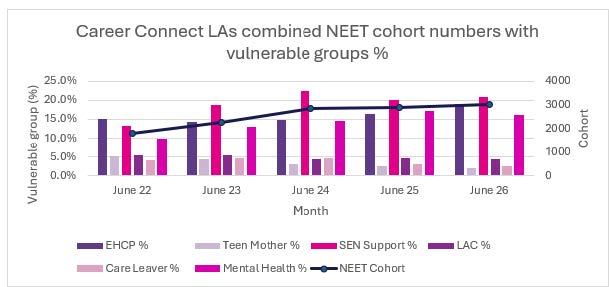
The combined NEET cohort has grown from around 1,800 young people in June 2022 to over 3,000 in June 2026. SEND and mental health needs feature prominently. By June 2026, around one in five young people had an EHCP and a
similar proportion were receiving SEN support, while mental health needs remain notably higher than in 2022. This reinforces the need for early identification and timely, personalised support in response to the variety of barriers that can increase the risk of NEET.
Meaningful first contact
Our experience shows that meaningful engagement requires persistent, personalised outreach — not simply an offer of support. The first Milburn report made it clear that the majority of young people want to connect to opportunities. But services are not always visible, accessible or easy to navigate. For those facing multiple and complex challenges, even contemplating next steps can feel impossible.
The responsibility is ours to reach out, build trust and keep the door to support open. We welcome Alan Milburn’s recent comments on the power of community outreach; physically knocking on doors to engage with young people is as important as having a Youth Hub nearby.
The scale of Career Connect’s home-visiting and localised outreach activity demonstrates our commitment to ensuring that the most vulnerable young people have equitable access to opportunities.
In 2025-2026 we provided tracking and support services for 43,245 young people, including identifying those who were NEET or at risk of NEET. The insight opposite shows the need for persistence.
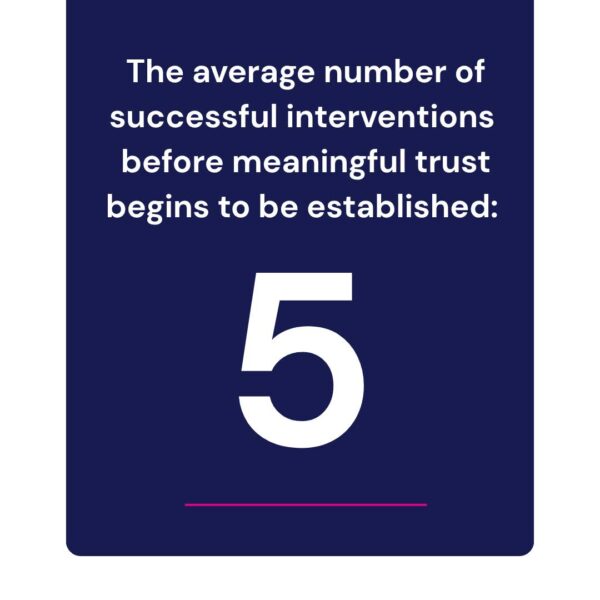
The responsibility to be proactive lies with the system – to prioritise persistent, tailored engagement and heightened visibility of careers support services.
The first phone call, text, card through the letterbox, or knock on the door – done in the right way – can be the start of transforming a life. And, once the young person connects into that support system, they must feel confident it will work for them.
The Career Connect model for sustained participation in careers support
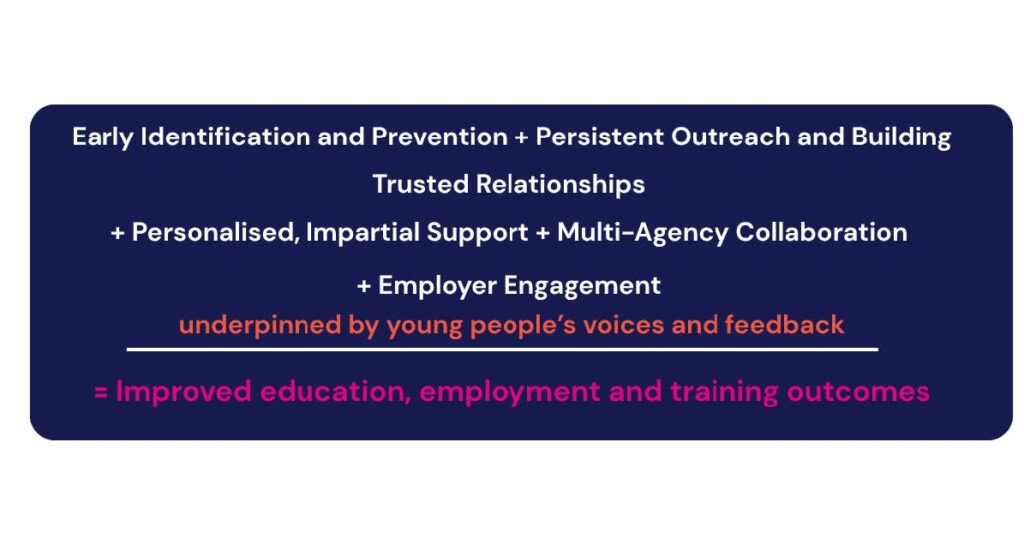
Take one element away, more young people fall through the cracks. Any full system reset must support each of these to work together – with accountability.
The model in action
Early identification and prevention
To enable high-quality, early identification, organisations should combine data intelligence, transition information, and local insight so that intervention takes place before disengagement becomes entrenched. Identification should include proactive youth voice activity – in a number of localities it has helped us to uncover young people who were hidden NEET and to identify unknown barriers to participation.
Persistent outreach and building trusted relationships
A ‘place-based, right place, right time’ approach brings support to young people rather than expecting them to access services independently. Home visits, community outreach, co-location with trusted partners, text and WhatsApp messaging, and flexible appointments are proven ways to build relationships and reconnect with young people who are Hidden NEET or Not Known.
Vulnerable young people should be prioritised, and every young person offered a named adviser and at least one face-to-face meeting. The focus of engagement should be on developing sustained, relationship-based support with a trusted adult, rather than transactional interventions. Regular attempts to engage must continue as long as the young person is eligible.
Personalised, impartial support
Caseload models help foster consistent, trusted, long-term relationships – critical for young people facing multiple and complex barriers. This empowers careers advisers to broker suitable learning, confidence, skills building and employment opportunities. Impartiality ensures young people have full agency and are the ultimate decision makers.Support must address goals and wider barriers such as mental health, anxiety,
SEND, confidence, life skills, poverty and social isolation. This relationship must evolve into in-work or in-education/training support – vital to sustaining progress.
Multi-agency collaboration
Careers services must work with local authorities, schools, colleges, social care, SEND teams, Youth Justice Services, health partners, employers and the voluntary sector to provide coordinated support around the young person. Systems must be connected, information shared, and support must be data-led and evidence based. Support must be easy to navigate.
Employer engagement
Connecting more young people to meaningful opportunities through employers, colleges, training providers, apprenticeships, supported internships and sector-based programmes aligned to local labour market demand. Guaranteed ‘Bridge the Gap’ opportunities for young people to ‘try and test’ training, education and employment opportunities – leading to softer outcomes that move a young person towards career readiness.
Any new system design must invest in every element of this model – and create a framework that makes it easy for each one to work together seamlessly, with the flexibility to respond to data insights and young people’s voices.
Recent media reports have stated that Alan Milburn’s upcoming report will call for “increased and sustained investment at scale,” into the £billions, for employment schemes. This is of course the news we want to hear.
When a young person is facing barriers, building trust before next steps takes time and persistence – and that means human resource. We hope to see investment in community models with a focus on outreach, and dedicated funds for every element of the model we propose, including sustained in-work/in-training/in-education support.
The test of success for any new system should not be whether a young person enters education, employment or training – but whether they are equipped and supported to stay, progress and thrive.